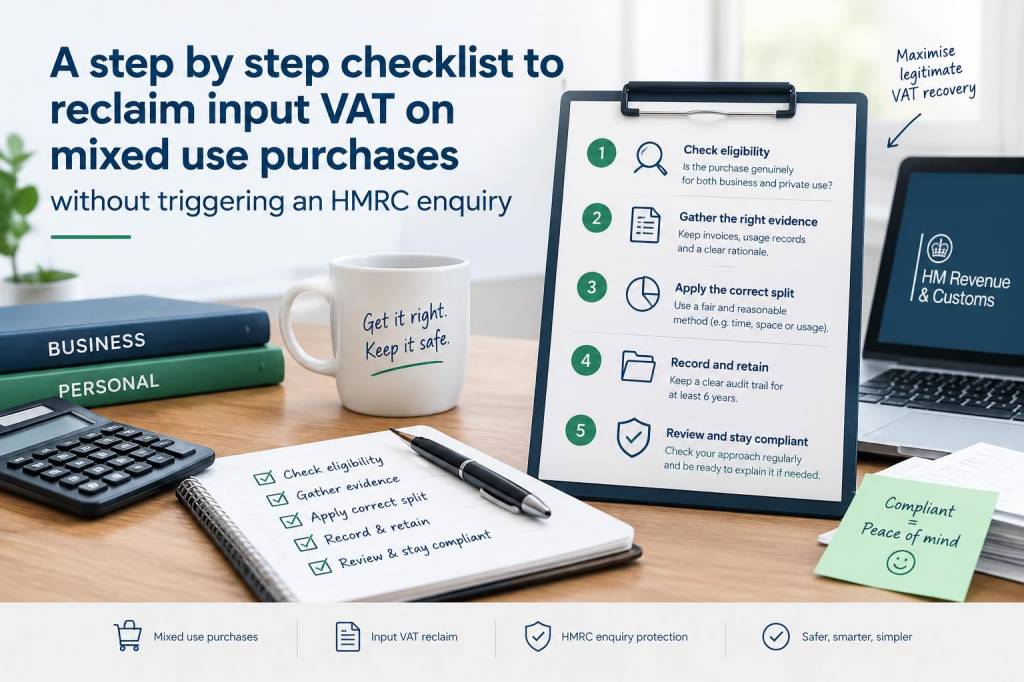
I often get asked by small business owners how to reclaim input VAT on purchases that are used for both business and private purposes without inviting unwelcome attention from HMRC. Mixed‑use items are one of those areas where a little care — and a clear paper trail — makes all the difference. Below I share a practical, step‑by‑step checklist I use with clients and in workshops, along with the reasoning behind each step and examples of allocation methods you can use. Follow these steps and you’ll improve your chances of a clean VAT reclaims process and reduce the risk of an enquiry.

Understand the basic rules first

Before you start, remember the fundamentals: VAT can only be reclaimed on purchases made for business use. If an item is used for both business and private purposes, you must only reclaim the business proportion. Getting this proportion right — and documenting how you arrived at it — is what keeps HMRC satisfied.

Checklist: what to do before you reclaim VAT

Work through this checklist each time you have a mixed‑use purchase. I recommend adding it as a standard step in your bookkeeping workflow (for example, as a rule in Xero or QuickBooks) so you never skip it.

  • Identify whether the purchase is exclusively business, exclusively private, or mixed‑use.
  • Decide on an allocation method and document your reasoning.
  • Keep detailed evidence of the purchase: invoice, payment proof, and any supporting notes showing how the item will be used.
  • Record the VAT claim in your accounting system with the business percentage and the calculation shown.
  • Keep ongoing usage records for assets or subscriptions (logbooks, calendars, mileage records, usage spreadsheets).
  • If the private use is minor and incidental, consider whether a standard apportionment rule applies (for example, 100% reclaim if private use is truly negligible) — document why you believe it is negligible.
  • When in doubt, seek professional advice before reclaiming — a short call with your accountant can avoid a lengthy HMRC query later.
  • Choosing an allocation method

    You’ll want an allocation method that is reasonable, consistent and evidentially supported. Here are the common approaches I use and recommend:

    MethodWhen to useExample
    Actual useBest for assets where you can track usage (e.g., a car or phone)Business calls 70% / Private calls 30% → reclaim 70% of input VAT
    Time‑basedServices or subscriptions used during set business hoursSoftware used 40 hours/week for business of 50 total hours → business use 80% → reclaim 80%
    Floor area or headcountOffice utilities or rent when part of property is personalHome office occupies 1 of 5 rooms → 20% business use
    Reasonable estimateSmall items where exact use is hard to track but private use is negligibleStationery for mixed social/business events — estimate business use 90%

    Record-keeping templates I use

    Documentation is your strongest defence. I suggest keeping these records, either digitally (scanned invoices, CSV usage exports) or in physical folders:

  • Invoice and payment proof saved with a short explanatory note (why the purchase was needed, who uses it).
  • Usage log (e.g., call logs, meeting calendars, mileage logs) covering the same VAT period as the claim.
  • Allocation calculation showing the math (for example, "Laptop cost £1,200 VAT £200. Business hours 80% → VAT reclaim £160").
  • If you use an allocation spreadsheet, keep version history or a dated note so HMRC can see the calculation date matches the VAT return.
  • Examples: common mixed‑use purchases and how I handle them

    Here are practical examples I share with clients.

  • Mobile phone — Keep a call/data usage report (many networks provide this). Use call minutes or data used for business vs private as the allocation. If you can’t get detailed usage, use a conservative estimate and document your reason.
  • Home internet — Use a time‑based or headcount method. If you work from home 4 days a week, weekdays 9am–5pm, you can reasonably claim a business proportion of broadband cost. Keep a simple calendar screenshot showing your working pattern.
  • Car — For VAT purposes, reclaiming VAT on car purchases is generally restricted. For fuel and running costs, use a mileage log to split business vs private journeys. I recommend digital apps like MileIQ or Fuelio to keep neat records.
  • Software subscriptions — Allocate by user accounts or hours used. If three of five seats are used for business projects, reclaim 60% of VAT.
  • What triggers HMRC attention — and how to avoid it

    HMRC is most likely to query VAT reclaims when they look inconsistent, undocumented, or unusually high compared to turnover or sector norms. To reduce that risk:

  • Keep allocations conservative. Don't overclaim to push your refund higher.
  • Be consistent. Use the same allocation method for similar items unless circumstances change — and document the change.
  • Avoid blanket percentages unless you can justify them with evidence for that category (for instance, “home office 15% across all utility bills with supporting calendar evidence”).
  • Retain records for at least six years — HMRC can open enquiries covering multiple years in certain situations.
  • When to disclose mixed‑use arrangements to HMRC

    If you make a significant change in how you claim VAT (for example, you start reclaiming on substantial assets with mixed use), consider a voluntary disclosure note on the VAT return or a short letter to HMRC. Transparency often prevents problems later. Your accountant can help word a succinct explanation that accompanies your return.

    Final practical tips I always give clients

  • Automate where possible — use accounting software like Xero, QuickBooks or Sage with attachments enabled so invoices and notes are stored with the ledger entry.
  • Label records clearly — “mobile phone bill – Dec 2025 – business use 65% (call logs attached)”.
  • Set a quarterly review — check mixed‑use claims for consistency and update allocation methods if business use patterns change.
  • Keep personal and business payment cards/accounts separate — it reduces the chance of accidentally reclaiming VAT on private purchases.
  • If you want, I can share a downloadable allocation spreadsheet template I use with clients or walk through a specific example from your business to check whether your proposed VAT reclaim looks robust. Just send the details and I’ll help you map it out.