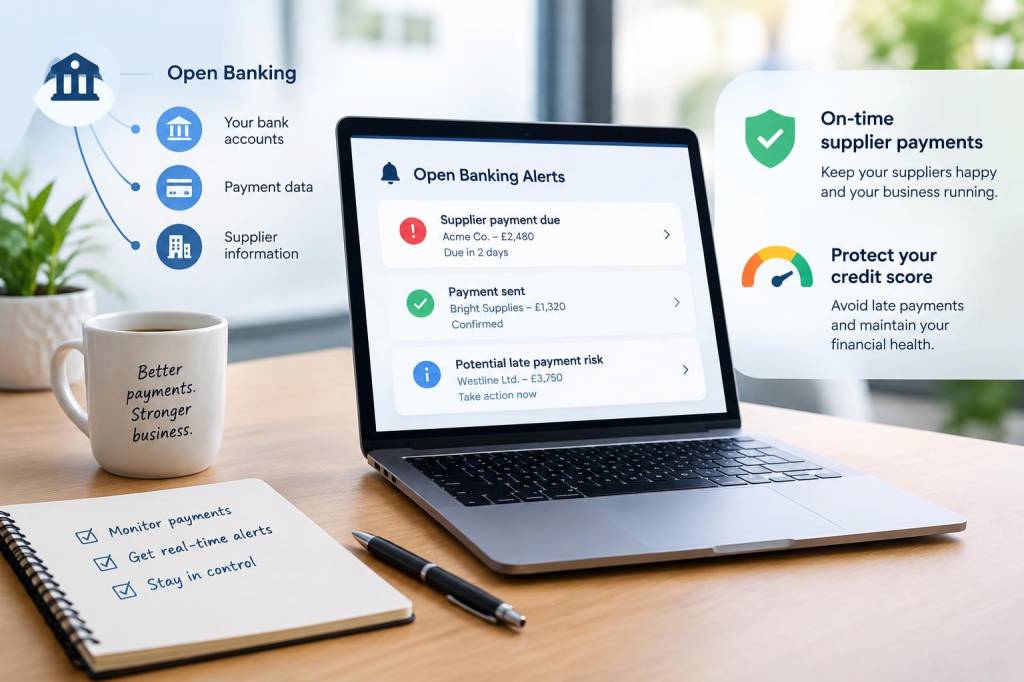
Late supplier payments are more than an administrative headache — they can strain relationships, trigger late fees and, importantly, damage your business credit score. Over the past decade helping UK micro‑businesses, I’ve seen how a well‑configured alerting system can turn reactive firefighting into calm, predictable cashflow management. Open banking alerts give you real‑time eyes on account activity and balances, so you can prevent late supplier payments before they happen.
What are open banking alerts and why they matter
Open banking lets third‑party apps and services access your bank data (with your permission) to provide useful features like balance notifications, upcoming payment reminders and payment confirmations. Alerts powered by open banking are typically faster and more reliable than traditional email or SMS bank messages because they draw directly from live bank feeds rather than batching updates. That speed is exactly what you need to stop payment slips from turning into late payments.
How open banking alerts help prevent late supplier payments
- Real‑time balance warnings: Get notified the moment your balance falls below a threshold needed for upcoming payments.
- Pending payment visibility: See when a scheduled BACS/CHAPS or standing order is due to leave your account, so you can move funds if necessary.
- Instant payment confirmations: Know immediately when a payment to a supplier has cleared, reducing unnecessary follow‑ups.
- Cashflow forecasts: Some apps use open banking to project cashflow, highlighting days when you might be short and suggesting corrective actions.
- Automated triggers to move money: Combine alerts with linked accounts (e.g., a business savings pot) to sweep funds automatically to cover a payment.
Quick setup checklist to start using open banking alerts
- Choose a reliable app or banking provider that supports open banking alerts (see provider examples below).
- Link the business current account(s) you use for supplier payments and any linked savings or credit facilities.
- Define payment thresholds and upcoming payment rules (eg. “Alert me if balance < £2,000 and there’s a payment > £1,000 scheduled in 48 hours”).
- Set preferred delivery channels: push notification, email, Slack, or SMS.
- Test alerts with a small scheduled payment to confirm timings and accuracy.
Practical alert rules I recommend
These are the alert rules I implement with clients — they’re simple, actionable and focused on supplier payments.
- 48‑hour low balance alert: If projected balance in 48 hours < payment obligations in next 72 hours → notify and suggest options (delay non‑essential spend, transfer from savings).
- Payment pending alert: When a CHAPS/BACS is scheduled → send a confirmation alert 24 hours before and on the day.
- Failed payment alert: Immediate alert on any failed or returned supplier payment so you can retry or contact the supplier straight away.
- Large debit alert: Any single outgoing > X% of average monthly outflows → immediate push notification.
- Credit buffer breach: If your balance would drop below an agreed buffer (eg. 10% of monthly revenue) → alert and auto‑sweep request to linked account or credit line.
Tools and providers that work well for small businesses
Not every app does the same thing. Below is a short comparison table of common choices for UK small businesses using open banking alerts. Pick one that fits your size and workflow.
| Provider | Strength | Best for |
|---|---|---|
| Monzo Business | Real‑time push notifications, easy rules, built‑in pots | Micro‑businesses wanting simple in‑bank alerts |
| Starling Business | Flexible notifications, instant payment confirmations, marketplace apps | Sole traders and growing SMEs with multiple apps |
| TrueLayer / Plaid (via apps) | Robust open banking connectors used by many fintech apps | Businesses that need bespoke apps or integrations |
| Cashflow forecasting apps (Fluidly, Float, Jirav) | Forecasts + alerts, scenario planning | Companies needing projection‑led alerts and planning |
| Third‑party alert services (Yolt, Emma) | Cross‑account aggregation and custom rule alerts | Businesses with multiple bank accounts seeking central alerts |
How alerts protect your credit score
Credit scores for businesses (and directors personally in some checks) can be affected by repeated late supplier or debt repayments. Open banking alerts protect your score by:
- Preventing late payments that would be reported to credit reference agencies or appear on supplier references.
- Reducing overdraft or misuse of credit lines — you can avoid hitting overdraft limits unknowingly.
- Giving you time to negotiate if a shortfall is detected — early communication with suppliers looks better than being late.
What to do when an alert shows a potential shortfall
When an alert warns you of an impending shortfall, take action in this order:
- Confirm the alert — check whether a large customer payment is pending that isn’t in the forecast.
- Prioritise supplier payments — identify critical suppliers (payscale, utilities, critical stock) and postpone discretionary invoices if cash is limited.
- Move funds — transfer from a business savings pot or a personal account if your policies allow.
- Use short‑term credit wisely — draw on an agreed overdraft or an invoice finance facility if available, but keep costs in mind.
- Contact suppliers proactively — explain the situation and offer a definite payment date or part payment to protect the relationship and credit references.
Common pitfalls and how to avoid them
- Relying on a single alert channel: If your push notifications fail, you may still miss a warning — set a fallback like email or Slack.
- Too many false positives: Set thresholds sensibly. If alerts trigger for every small fluctuation you’ll ignore them.
- Not linking all accounts: Aggregation works only if every relevant account (savings, merchant accounts) is connected.
- Ignoring supplier terms: Alerts help you act — but you must prioritise payments and renegotiate terms where necessary.
Sample alert message templates
Use these short templates for push notifications or Slack messages so your team can act fast.
- 48h Low Balance: “Alert: Projected balance in 48h is £X, payment obligations > £Y. Suggest transfer £Z from Savings or delay non‑essential spend.”
- Payment Scheduled: “Reminder: Supplier payment £A scheduled for DD/MM. Confirm funds available or reschedule by [time].”
- Payment Failed: “Urgent: Payment to [Supplier] for £B has failed. Retry now or contact supplier to avoid late fees.”
Setting up open banking alerts isn’t a one‑time task — it’s an operational habit. Start small: pick one or two critical rules, test them for a month, and then expand. When used thoughtfully, these alerts stop late supplier payments before they happen and give you the breathing room needed to protect your business credit and relationships.