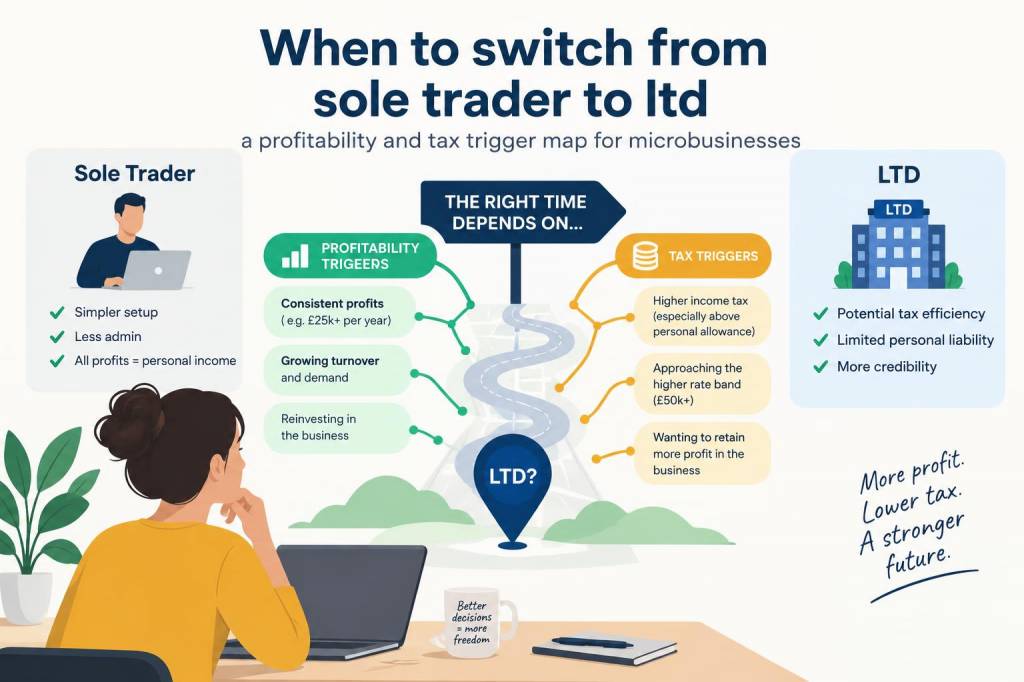
I remember the moment a client looked up from their laptop and asked, “Lea, when should I stop being a sole trader and become an LTD?” It’s one of those questions I hear weekly. There isn’t a single magic number, but there are clear profitability and tax “triggers” that make switching sensible for many microbusinesses. I’ve pulled together a practical map you can use to decide — with the real‑world pros, cons and step‑by‑step actions you can take if you choose to incorporate.
Why this matters — a quick framing
As a sole trader you and your business are the same legal entity. That simplicity is fantastic early on: fewer accounts, simpler tax returns, and lower costs. But as profits grow, tax, risk and growth opportunities change the picture. Incorporating into a limited company separates you personally from the business, introduces corporation tax, and creates opportunities to optimise how you pay yourself — but it also brings extra admin, payroll obligations and different compliance risks.
Key financial triggers to watch
Think of these as signals rather than absolute rules. Multiple triggers aligning is a stronger signal that incorporation could be beneficial.
Net profit consistently above £12,000–£15,000 after expenses — you’ll be paying Income Tax and Class 2/4 NICs as a sole trader. Once profits pass roughly the range where combined Income Tax plus NICs start to exceed the effective tax rate you could achieve by splitting salary and dividends, incorporation becomes worth modelling.Net profit above £30,000–£50,000 — for many service businesses this is the classic range where limited company tax planning (salary + dividends) typically outperforms sole trader tax. The exact tipping point depends on personal circumstances such as pension contributions, other income and family tax position.You want to retain profits in the business — if you plan to reinvest earnings to grow, pay down debt or buy equipment, a company pays corporation tax (currently 25% for many businesses from April 2023, with small profits rate nuances). This can be lower than higher marginal personal tax rates and keeps money in the company for future investment.You’re taking a large salary or need a predictable personal income — PAYE becomes necessary and you’ll need to run payroll (RTI). Limited companies allow a tax‑efficient blend of small salary + dividends.You’re hiring or will hire staff and want clearer pension and employment frameworks — companies have clearer processes for auto-enrolment pension staging and employment contracts.Risk and liability are concerns — incorporation can protect personal assets from business debts (subject to director duties and personal guarantees).You’re seeking external investment or planning for sale — investors and buyers often prefer the share structure of a limited company. Exit through the sale of shares can be more tax‑efficient than selling sole trader goodwill.Simple tax comparison table (illustrative)
| Scenario | Sole Trader | Limited Company |
| Profits retained in business | All profits taxed via personal Income Tax and NICs | Taxed at Corporation Tax; lower rate can leave more in company for reinvestment |
| Paying yourself | All drawings treated as taxable income | Small salary (PAYE) + dividends (dividend allowance then rates) — often lower overall tax |
| Admin burden | Annual Self Assessment; bookkeeping; simpler | Companies House accounts, corporation tax return, payroll, dividends paperwork |
| Liability | Unlimited personal liability | Limited liability (subject to director conduct) |
How to test whether you’re at the tipping point
I recommend a simple three-step modelling exercise you can do in a spreadsheet or ask your accountant to run:
Project your next 12 months’ expected net profit before personal drawings.Compare current sole trader tax (Income Tax + Class 2/4 NICs) vs company route: corporation tax on profits, a sensible director salary (near the NIC threshold or personal allowance), then dividends for the remainder. Don’t forget Employers’ NICs, pension contributions, and dividend tax bands.Factor in other practical items: increased accountancy fees (you’ll pay more), payroll setup costs, Companies House filing, and potential savings in National Insurance and Income Tax.Non‑tax triggers that matter
Tax is important but not everything. Consider these operational and strategic triggers:
Professional perception — Some clients and suppliers take LTDs more seriously, especially in B2B or when tendering.Access to contracts and supply chains — Certain platforms or marketplaces require a company structure for supplier agreements.Risk tolerance — If you’re taking on higher commercial risk or debts, limited liability can be an important shield.Future exit plans — If you want to sell, bring in partners or external investors, a company structure is almost always preferable.Practical steps to switch if you decide to incorporate
If your modelling and non‑tax triggers point towards incorporation, here’s a checklist I follow with clients:
Speak to an accountant and run a personalised tax comparison. Online calculators are helpful but don’t replace tailored advice.Decide on company structure: single director/shareholder vs multiple directors, share classes, and who holds shares.Register the company at Companies House (I often recommend using the GOV.UK service or a trusted provider like 1st Formations or Rapid Formations for extra guidance).Set up a business bank account in the company’s name — most banks now support quick online onboarding for LTDs.Register for Corporation Tax with HMRC within three months of starting to trade as the company.Close off your sole trader Self Assessment period correctly — final tax year, Class 2/4 NICs, and any capital allowances adjustments.Set up payroll (PAYE) and pensions if you’ll pay a salary or have employees; consider using Xero Payroll, QuickBooks Payroll or FreeAgent depending on your bookkeeping software.Document any transfer of assets or client contracts from sole trader to company — seek advice to avoid unexpected VAT or capital gains consequences.Review your insurance (professional indemnity, public liability, employers’ liability) and update policies to name the company.Common mistakes I see
Switching structures can deliver big benefits, but only if done with the right steps:
Not modelling personal cashflow — lower tax bills on paper don’t help if you can’t extract money when needed.Failing to document director dividends properly — HMRC expects minutes and accurate records.Overlooking the extra accountancy fees — budgeting for bookkeeping, payroll and company accounts is essential.Rushing to incorporate because of one profitable year — look for patterns across multiple months/years where possible.If you’d like, I can run through your numbers with you and map the exact profitability threshold for your circumstances — I often do short, affordable health checks that save clients more than they cost. Switching is a practical decision, and when it’s timed right it can reduce tax, manage risk and position your business for growth.