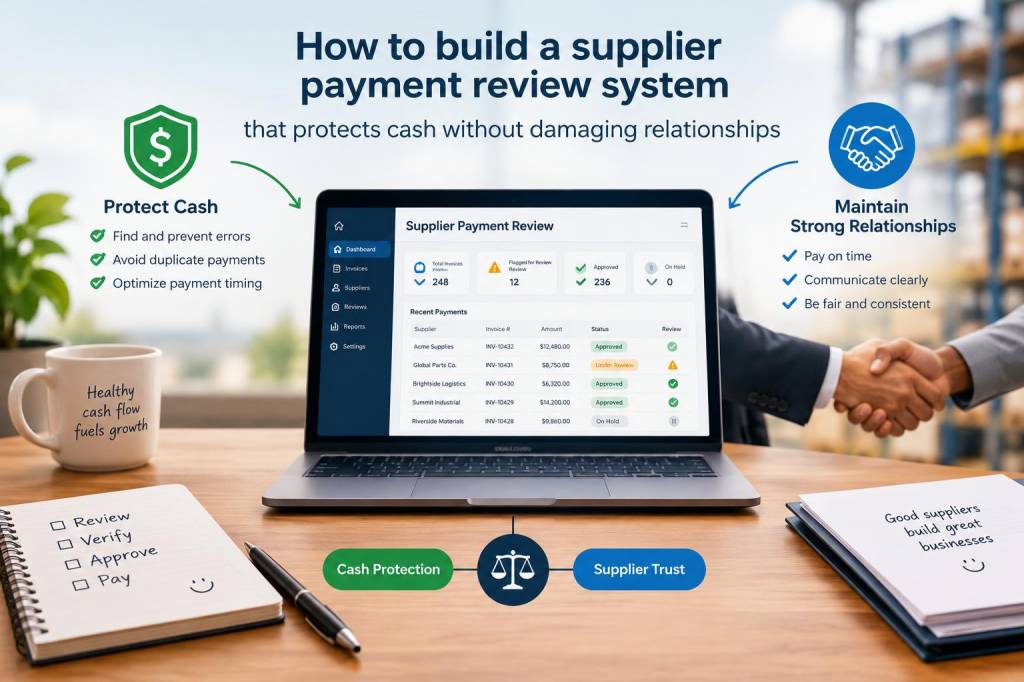
I have learned that supplier payment control is one of those areas where a business can quietly lose cash, time, and trust at the same moment. If payments are rushed, cash can disappear faster than planned. If payments are delayed without a clear process, suppliers start to feel uncertain, and that uncertainty can turn into stricter credit terms, awkward calls, or even halted deliveries. What works for me is a payment review system that is structured enough to protect cash, but human enough to protect relationships.
Why payment review should feel like a routine, not a rescue plan
In many small businesses, payment decisions happen reactively. A bill arrives, someone flags it, and then the question becomes whether it can be paid today. That approach creates pressure, and pressure often leads to mistakes. I prefer a system that treats every supplier invoice as part of a wider cash plan.
When I review supplier payments, I am not asking only, “Is this bill valid?” I am also asking, “Is this the right moment to pay, and what will happen if I do?” That second question matters because a payment made one week too early may reduce flexibility just when payroll, VAT, rent, or stock purchases are coming up. On the other hand, a payment delayed without explanation can damage a relationship that took years to build.
A good review process gives me a calm way to decide which bills need action now, which can wait, and which need a quick conversation with the supplier before anything is paid.
The information I want in front of me before approving a payment
I never want to rely on memory when supplier payments are on the table. Memory is where small errors grow. I want a simple view that shows me what is due, what is disputed, what is routine, and what is sensitive. For a small business, this can be managed in a spreadsheet, an accounting package, or a shared payment approval tool, as long as the data is reliable.
The key details I look for are:
- Invoice number and date
- Supplier name and contact details
- Payment terms and due date
- Amount due and currency
- Purchase order or contract reference
- Goods received or service confirmation
- Any disputed item, credit note, or missing detail
- Payment method and bank details
This list may look basic, but it saves a great deal of trouble. If I cannot see whether goods were received, whether the price matches the order, or whether the due date is genuinely urgent, I am not ready to approve payment. I also want to know whether the supplier is strategically important, because not every invoice carries the same relationship risk.
My payment review rhythm
The strongest systems are repetitive in a good way. I like a payment rhythm that is easy to follow and difficult to skip. In practice, that means I set regular review points rather than making decisions on the fly.
A simple rhythm might look like this:
- Review incoming invoices twice a week
- Check due dates against forecasted cash balances
- Flag any invoice above an agreed approval limit
- Confirm disputed or unusual items before payment
- Prepare a payment run list and approve it in one place
- Record any supplier communication linked to delayed payment
I like to keep this process predictable because predictability reduces friction. Staff know when invoices will be checked. Suppliers learn that payment decisions are made carefully, not randomly. Even within a small team, that consistency improves confidence.
Cash protection without creating supplier anxiety
Protecting cash does not mean squeezing every supplier for as long as possible. That may look useful in one month, but it can create expensive problems later. Some suppliers offer better service, better availability, or better terms because they trust the customer relationship. If they feel ignored, they may shorten terms, ask for deposits, or refuse urgent work.
What I have found useful is a payment priority framework that separates urgent from important. Urgent items are those that could trigger service interruption, late fees, or operational disruption. Important items are those that matter to the business but have a little flexibility in timing. By separating them, I can protect cash where possible without making poor choices about relationships.
For example, a software licence that will suspend access tomorrow is urgent. A recurring invoice from a supplier with excellent terms and no immediate pressure may be important, but not necessarily urgent. That distinction helps me decide where to keep cash today and where to pay promptly to preserve goodwill.
How I handle suppliers when payment must be delayed
Delays happen, even in well-run businesses. A payment review system should not pretend otherwise. What matters is the way the delay is handled. I have found that most suppliers respond far better to honest communication than to silence.
If I know a payment cannot be made on the due date, I prefer to contact the supplier before the due date arrives. That message should be direct, calm, and specific. I avoid vague promises. Instead, I explain what is happening, when payment is expected, and whether a partial payment is possible.
Useful points to include in a supplier conversation are:
- Acknowledgment that the invoice is valid
- Clear explanation of the reason for delay
- A specific proposed payment date
- Any partial payment being made now
- A commitment to update them if anything changes
I have seen relationships improve simply because a business took the time to communicate early. A supplier who feels informed is far more likely to stay flexible than one who is left chasing payment without context.
Approval limits and why I use them
One of the easiest ways to avoid rushed mistakes is to set approval limits. Not every invoice should follow the same route. Smaller, routine bills can often be approved quickly, while larger or unusual items should be reviewed more carefully.
I usually like to define limits based on risk rather than only on size. A low-value invoice from a new supplier may deserve more scrutiny than a high-value recurring bill from a long-standing partner. Approval limits can also be matched to role. For example, one person may prepare the payment run, while another approves it. That separation gives extra control without making the process heavy.
| Payment type | Review level | Why it matters |
|---|---|---|
| Recurring utility or software bill | Standard review | Usually predictable and easy to verify |
| High-value stock purchase | Detailed review | Affects cash and trading capacity |
| New supplier invoice | Enhanced review | Higher risk of error or fraud |
| Urgent service invoice | Fast-track review | May affect operations if delayed |
| Disputed invoice | Hold and resolve | Payment should wait until facts are clear |
Using cash flow data to decide payment timing
I never want supplier payments to be isolated from cash flow forecasting. When I know what cash is likely to come in and what must go out, payment decisions become much easier. Even a simple thirteen-week cash forecast can transform the way a business pays suppliers.
I look at timing in three layers. First, I check the bank balance and near-term commitments. Second, I review any expected receipts that are reasonably secure. Third, I consider whether any payments can be delayed safely without harming the relationship or the business. That final point is crucial, because “safe” does not mean “possible in theory.” It means the delay can happen without real damage.
If I see a cash pinch coming, I would rather adjust the payment schedule early than wait until the bank balance forces a rushed decision. The earlier I spot the pressure, the more options I have. Sometimes that means paying some suppliers on the due date and moving others by a few days after a conversation. Sometimes it means changing purchase timing so a future bill does not arrive too soon.
What I track to know whether the system is working
A payment review system should not just exist on paper. I want to know whether it is improving cash protection and preserving supplier trust. To check that, I track a small set of practical measures.
- Number of invoices paid on or before due date
- Number of delayed payments and reason for delay
- Supplier complaints or payment chasers received
- Late fees or interest charged by suppliers
- Cash saved through delayed payment timing
- Any supply disruption linked to payment issues
If late fees are rising, the system is too loose. If supplier complaints are increasing, the communication side needs attention. If cash is improving but relationships are weakening, the business is probably pushing too hard. The right system should create balance, not just delay bills.
Practical habits that make a real difference
Some of the most effective changes are simple habits repeated well. I always encourage businesses to make payment discipline visible, because hidden systems tend to drift. A clear shared process means fewer surprises and better decisions.
- Match invoices to orders before approval
- Keep supplier contact details current
- Review due dates against forecasted bank balances
- Record every agreed payment extension in writing
- Use consistent payment runs rather than random ad hoc payments
- Keep a short list of priority suppliers whose timing matters most
- Recheck bank details to reduce fraud risk
I also like to keep a short note beside each supplier account explaining any special arrangement. That might include payment frequency, an agreed extension, seasonal purchasing patterns, or a contact person who prefers email over phone calls. Those small notes help avoid awkward mistakes later.
Where small businesses often go wrong
In my experience, the biggest mistake is treating every supplier the same. Some invoices need immediate attention, while others can wait. Another common issue is failing to communicate early enough. A business may think it is being polite by saying nothing until it has the money, but silence is usually more damaging than a frank conversation.
I also see businesses rely too much on one person’s memory or inbox. If payment decisions live in a single head, the process is vulnerable. Staff leave, inboxes fill up, and the history disappears. A proper review system stores key decisions in a place where others can see them.
Finally, some businesses assume that paying later is always better for cash. That is not true. Paying later can help in the short term, but only if it is managed carefully. When it becomes routine without discipline, the business may lose negotiating power, supplier goodwill, and control over the numbers.