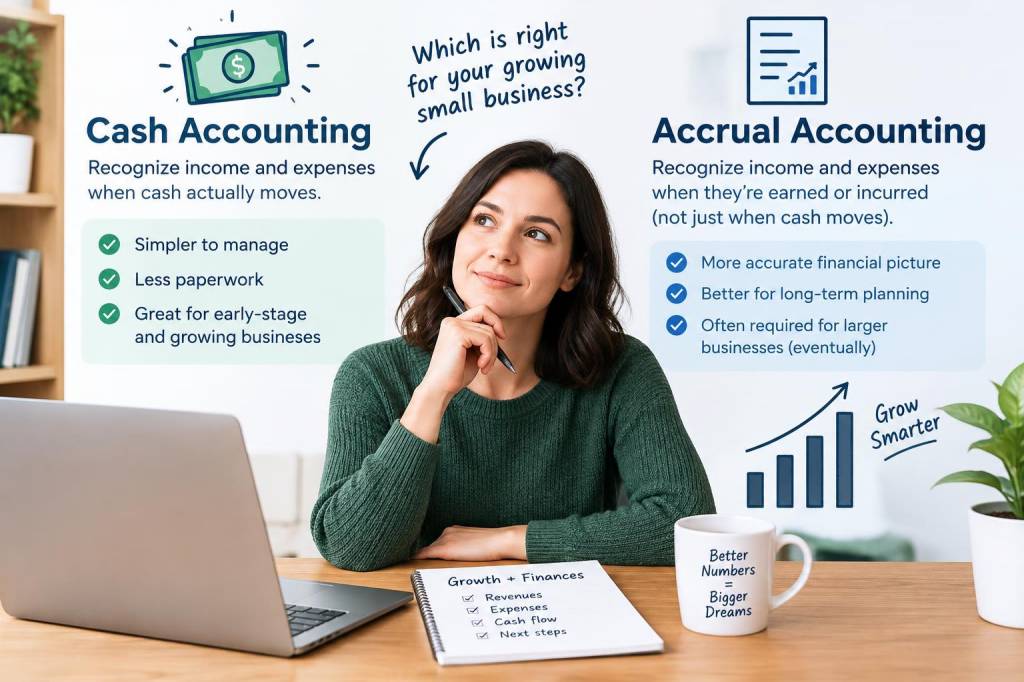
When I speak with growing small business owners about bookkeeping, one question comes up again and again: when does cash accounting make more sense than accruals? It is a practical question, not just a technical one. As a business grows, the bookkeeping method you choose starts to affect tax timing, reporting clarity, cash flow planning, and even how confidently you make decisions. I have seen owners stay with one method simply because it felt simpler, only to realise later that the numbers were no longer giving them a clear picture of performance.
My view is that cash accounting can be a very useful option for certain small businesses, especially in the early and lower-complexity stages of growth. But I would never choose it just because it seems easier. I choose it when it matches the way the business earns, spends, and manages money. That distinction matters, because the wrong method can hide growing risks or make a healthy business look weaker than it really is.
What cash accounting actually shows
Cash accounting records income when money arrives and expenses when money leaves the bank. If you send an invoice in March but get paid in April, cash accounting treats that sale as April income. If you receive a supplier bill in June but pay it in July, the expense appears in July. This means the records follow bank movement rather than economic activity.
That simplicity is exactly why many owners like it. It mirrors bank balance movements, is easier to track, and can reduce the bookkeeping burden for very small teams. When I work with businesses that have straightforward invoicing, quick payment cycles, and limited stock, cash accounting often feels intuitive and manageable.
Accrual accounting works differently. Income is recorded when it is earned, and expenses are recorded when they are incurred, whether or not the money has moved yet. That gives a more complete picture of performance, especially when a business carries debtors, creditors, stock, prepaid costs, or deferred income. It is usually more suitable once transactions become more layered.
When cash accounting can be a sensible choice
I usually consider cash accounting when a growing small business still has relatively simple operations and the owner needs a clear view of actual cash coming in and out. In practice, that can include service businesses, consultants, creatives, trades, and small agencies with modest transaction volumes.
Cash accounting can be a strong fit when:
- Most clients pay quickly, with little overdue debt
- Supplier bills are paid soon after receipt
- There is little or no stock to track
- The business does not need detailed margin analysis by project or period
- Cash flow is more important than monthly profit smoothing
- The owner wants simpler bookkeeping and fewer year-end adjustments
I often see this method work well for owner-managed businesses that are still lean, where the founder is doing much of the financial admin personally or with light support from a bookkeeper. In that setting, cash accounting can reduce friction and make routine bookkeeping less time-consuming.
It can also be helpful when the business owner tends to make decisions from bank balance rather than from accounts reports. If that is already how the business is managed, cash accounting may align better with real-world habits, provided the owner understands its limits.
When I would not rely on cash accounting
As a business grows, cash accounting can become too blunt. I start to move away from it when the business has a meaningful gap between invoicing and payment, or when expenses and revenue do not line up neatly within a single month.
I am cautious about cash accounting when:
- The business offers credit terms to customers
- There are significant unpaid invoices at month-end
- Stock or inventory is part of daily trading
- Projects span several months
- Large annual bills are paid in one lump sum but used over time
- The owner needs accurate monthly profit reporting for lending, investors, or internal planning
In these cases, cash accounting can create a distorted picture. A busy month may look profitable simply because several invoices were paid, while another month may appear weak because key customer receipts have not landed yet. That distortion can make it harder to judge pricing, staffing, and investment decisions.
I have also seen owners underestimate tax exposure because money has not yet reached the bank, even though income has already been earned. That is one of the biggest traps. Cash in hand is not always the same as profit earned, and those two ideas should never be confused for long.
The signs that a growing business may be ready to switch
There is no single revenue threshold that tells me a business has outgrown cash accounting, because size alone does not determine complexity. Instead, I look for operational signals. If any of these are starting to appear, I usually pause and review the method carefully:
- Debtor days are increasing and unpaid invoices are building up
- Supplier terms are lengthening and payables need active management
- Monthly reporting no longer matches commercial reality
- Cash flow feels tight even when sales are strong
- The owner cannot explain margin by customer, service, or month with confidence
- Year-end adjustments are becoming large and time-consuming
That last point matters more than many people realise. If I have to make heavy year-end corrections to turn cash records into meaningful accounts, I ask whether the current method is still serving the business. Bookkeeping should support decisions throughout the year, not only produce a compliant file at the end.
I also watch for moments when the business is preparing for more ambitious growth: hiring staff, taking on larger contracts, seeking finance, or investing in systems. Those are often the points where accrual reporting becomes much more valuable, because it helps owners see committed costs, earned income, and true performance more clearly.
Tax timing is not the same as business health
One reason owners like cash accounting is that it can delay tax on unpaid income. That can help short-term cash flow, and I understand why that appeal is strong. If a client has not paid yet, it feels natural not to want to pay tax on money that has not arrived.
Still, I always remind owners that tax timing should not be the only factor. A method that improves short-term tax timing may still be a poor choice if it hides performance problems or makes planning harder. I prefer to think about the whole picture: tax, reporting, administration, cash flow, and decision quality.
For some businesses, cash accounting offers a useful balance. It reduces admin and aligns tax with receipts. For others, especially where margins are tight or growth is rapid, accruals give more useful information even if the bookkeeping work is a little heavier.
Comparing both methods in everyday terms
| Area | Cash accounting | Accrual accounting |
|---|---|---|
| Income recognition | When money is received | When sale is earned |
| Expense recognition | When money is paid | When cost is incurred |
| Ease of bookkeeping | Usually simpler | Usually more detailed |
| Cash flow visibility | Very direct | Requires separate cash flow review |
| Profit accuracy for a period | Can be distorted by timing | Usually more accurate |
| Best fit | Simple, service-led businesses with quick payment cycles | Businesses with stock, credit terms, projects, or growing complexity |
When I review a client’s books, I do not ask which method is simpler in theory. I ask which method gives a more honest view of what is happening in the business right now. That is the real test.
Questions I ask before recommending a switch
Before I move a growing business away from cash accounting, I usually ask a few practical questions:
- How long does it take customers to pay?
- Do unpaid invoices materially affect monthly results?
- Are there items purchased in one period and used across several periods?
- Does the owner need monthly profit figures that match trading reality?
- Is stock becoming an important part of the business model?
- Would lenders, partners, or advisers expect accrual-style accounts?
If most answers point toward more complex trading activity, I start planning a transition. I do not treat that as a failure of cash accounting. I treat it as a sign that the business has matured. A bookkeeping method should evolve with the business, not lock it into an older stage of growth.
What usually happens when I move a client from cash to accruals
The first thing I do is clean up timing issues. That means reviewing unpaid sales invoices, unpaid bills, prepaid items, and any income or costs that belong in a different period. I also make sure the client understands that reported profit may change once the new method is in place. That change is not a problem; it is often a correction toward reality.
I usually warn owners that the first set of accrual accounts can feel unfamiliar. Profit may look lower or higher than expected depending on invoicing patterns. That is normal. Once the business gets used to it, the reports tend to become much more useful. Owners can see what was actually earned in a period, what costs were truly incurred, and where operational bottlenecks are appearing.
I have found that switching methods can also improve conversations with advisers, banks, and internal decision-makers. When everyone is working from a clearer profit picture, planning becomes easier and arguments about “why the bank balance says one thing but the business feels different” become far less common.
My practical rule of thumb for growing businesses
My rule is simple: I am comfortable with cash accounting while the business is still small, predictable, and heavily cash-focused. I become less comfortable once unpaid invoices, stock, project work, or longer payment cycles begin to shape the real economics of the business.
If cash accounting helps a busy owner stay organised and focused, I will use it. If it starts hiding the truth, I want accruals instead. Growth changes what good bookkeeping needs to do. Early on, simplicity may be enough. Later, clarity matters more than convenience.
That is why I always look at the business model, not just the balance of the bank account, before deciding whether cash accounting is still the right fit.